
Second Helpings: William Caleb Rivera-Bloodworth, Artist, Designer, Advocate


Enjoy this Second Helpings episode as we reconnect with Caleb our Season 1 Episode 2 guest to see where he is now 5 years down the road and how things have changed and how he has grown along the way.
Follow Caleb in Instagram - @wcrbdesign
Check out his website (and buy some art!) WCRB.design
Check out the winterROCs art festival too! winterROCs.com
If you'd like to support this podcast, you can buy me a coffee HERE.
Check out the "Keep the Darkness at Bay" Journal & T's Here
I'd also appreciate it if you left a 5 star rating and review for the podcast on whichever platform you listen on. Thank You!
Special Thanks To:
@jasonthe29th - Logo Design
@jacobjohnsontunes - Theme Music
Pod Decks - Fast 5 Questions
DISCLAIMER: Some of the links here are affiliate links, which means I will make a small commission if you click them and make a qualifying purchase, at no extra cost to you :)
*I hereby solemnly swear to only promote products and services I actually love and use in my podcast and everyday life!
Ellia
Please sir, could I have some more?
Robb
Welcome to another episode of Chewing the Fat, our very first Second Helpings episode of Chewing the Fat, where we talked to some guests that we've had on before, and I get to connect right now with a friend of mine who has been in my life for many, a many a year, but uh he happened to be in town and I was like, hey, let's do this thing. So please welcome to tell his beautiful, messy human story, William Caleb Rivera Bloodworth. Caleb.
Caleb
Hello, hello. So happy to be here in person.
Robb
I know, right. Last time we did this, everybody was locked down.
Caleb
Yeah.
Robb
You were in a little Zoom square. I was in a Zoom square when we uh uh recorded episode two of the podcast. Now we're well over a hundred episodes and uh five years.
Caleb
Congratulations to you for that.
Robb
Thank you. Thank you. Um, you know, it's uh I've had people ask before, it's like, oh, you should we should do like a where are they now type thing and see? And so, you know, the star is aligned and you are here. And so I love it. Here we here we are.
Caleb
I don't and I don't have to be worried about what my my headphone microphone is picking up. I mean in your fancy studio recording live with you.
Robb
Well, I mean, you know, through through the windows in Rochester, I mean, is you you never know you never know what you could hear, right?
Caleb
Absolutely.
Robb
So Caleb and I worked together at the fruit stand, as we like to affectionately call it. Uh, for many a year. Uh Caleb left uh the area here and went up to Rochester, New York. Um to actually you transferred to the fruit stand up there.
Caleb
Different orchard.
Robb
Yeah, and uh but then you know, as life goes, we we become different people and and needs aren't met, and we we decide, you know, what we need to do with our life. And your transformation into the person that you are now has been wonderful to see.
Caleb
Oh, thank you.
Robb
Uh keeping in touch with you, following you on social media, uh to see you become this amazing artist that that obviously was there, but just didn't know, either didn't have the confidence, didn't have the um, you know, whatever it was to to find that. And and it took you moving so because you're because you're from the south, you're from uh around Rome, Georgia area, right?
Caleb
Uh even further north, so right up near near Chattanooga, Tennessee, actually, but on the Georgia side.
Robb
Yeah. So I mean, so you've homegrown, you know, here, but to to move to to the border of another country. Southern Canada. Yeah, you know, uh to really find yourself. I know people talk about going on those journeys and finding themselves, but uh for me, and again, I'm just an observer, I feel like you truly did um find yourself uh in moving away.
Caleb
Yeah, I I appreciate you noticing and saying that. I I think more than anything, it's been a returning to rather than a becoming. Okay. Um but you're right, in terms of a I think who I was, what I was doing with my free time as well as professionally was very different when I was still in Augusta versus now eight and some change years later, just life circumstances have changed, and then I've learned to just go back to the things that made me really happy when I was a lot younger and just didn't make that connection until after I had moved.
Robb
Yeah, yeah. And do you remember, was there like a pivotal point that you were like, aha, you know, that that paradigm shift, as they call it. Um, where or was it just a gradual like, these things aren't serving me? Let me get back to the things that really you kind of set my soul on fire when I was younger.
Caleb
Yeah. And so I know when I was on before, I talked about in the the COVID shutdown, not really having anything else to do and sort of thinking, huh, I used to paint like when I was in high school, why don't I just Amazon some some painting materials over to my little bubble and and see how that goes. And so I feel like when I recorded with you last, it was still very early on in that. I knew that I had latched onto something that felt very healing. Um, and it was just great to have a creative outlet. Um, but in the five years since then, it's really become the thing that gets me up every morning. And it's, you know, thinking back on it, when I was in middle school and high school, I was doing graphic and web design for funsies while the other children were outside playing sports. And so all of that was already there. I didn't do a lot in the way of painting until high school art class. And then every couple of years, there'd be some sort of paint and sip situation that I would go to and I would really like it.
Robb
Yeah.
Caleb
But it was definitely not anything I was doing on the regular until COVID.
Robb
Yeah.
Caleb
You know, about three or four months into the shutdown, sort of, huh? Well, I guess I could try doing art to keep myself occupied now that I've color-coded all of my books and rearranged all the Tupperware and the cabinets. Right. Um and uh yeah, it's just like I said, it's it's more of a returning to.
Robb
Yeah, I love that. I love that. Now, I mean, the the existential question that that may not have an answer is like, do you think you would have come to that point had we not been shut down?
Caleb
I really don't know. I I want to say I hope I would have gotten there eventually, but I don't think it would have been that fast. Um I mean, obviously it was on a global scale, complete tragedy all around.
Robb
Right.
Caleb
And also, I mean, the indomitable human spirit of being put in a almost completely unprecedented situation. What do you do with your time when everything you've known is now different?
Robb
Yeah.
Caleb
It's that if you go into it with a growth mindset, there are things that you learn that you pick up that you didn't expect to.
Robb
Yeah. Yeah. Yeah. I think and I think that happened for a lot of people. Um, you know, because again, you're like, well, what do we do? What do we do? You know, a lot of people turn to the arts for entertainment. It's like, well, what, you know, and I need something to watch on YouTube or television, or, you know, they they're not making new stuff. Well, I maybe I can make some stuff. And you have access to technology like iPhones and things like that that can do amazing things, terrible, blood-amazing things.
Caleb
Dumbledore. Right, you know, but it's like Oh no, that's all of Anna. That's all of And. I was like, I know that I know that we're in the wizarding world, but continue. Yeah.
Robb
But yeah, you know, so so it's like, all right, what what do I do? And a lot of people, you know, there was the whole sourdough bread, you know, phase where where people now have businesses making sourdough bread that they wouldn't have had had they not been, you know, cloistered in their house and can't do anything else. Absolutely.
Caleb
And I will say I did also buy a KitchenAid mixer in in the shutdown. Yeah. And that whole baking piece didn't quite work out the same way that the painting did. Right, right.
Robb
But that's the thing. It's like, you, you know, it's like, all right, what do we do? How do I how do I spend my time? It's like, all right, you know, there yeah, there are places that are adapting, allowing you to work from home. And that whole thing about once it was over, okay, go back to work. But why? I was so productive from home. Why do I have to go travel this hour into work and and and do less productive work and travel back home?
Caleb
Absolutely. Why? Especially when for a lot of us, our workplaces are still involving a lot of meetings where there are remote participants. And so there definitely have been times where you're going, I just commuted to the office to get on a computer and look at someone who's not there, right? So some of that sort of separation and social isolation that we had in the first part of the pandemic, I think we still haven't quite shaken it off. I think we've had a lot of new opportunities to collaborate with folks that we might not have otherwise been collaborating with directly. And uh, you know, maybe don't tell your staff to come in in person if everyone's not going to be there in person. Right. Right.
Robb
Yeah. Yeah. I I I 100% agree with that. And especially when you look at like the productivity with a lot of folks, it's like, well, they're much more better, they're much happier, they're better employed, they're more willing to go out of their way from home, as opposed to grumble, grumble, I had to get on the subway, grumble, grumble, I had to drive 30 minutes to an hour to go and work, find parking, pay money for coffee that was at home that I could have just had four cups already, you know, whatever. You know, uh it's like let's if if we've we've made a shift in what the world is and how things can work, and we've made the world smaller through technology, let's let's expand from that. It does and it and and and change what it is. It's like, I'm sorry you had a you know 70-year lease on this building because that's what you thought the world was gonna need to be. But like pay it off and let your people stay at home and do good work for you. Oh, absolutely, absolutely. I mean, I don't know. Um so for you um in this uh journey into back journey back to art, what was that first uh inkling? You I know you said Amazon get some paints. Was it just you know, Pollock throwing paint against the canvas type stuff or or was it like, you know, the you can draw and uh let me do the teddy bear with the with the hat on it or something or what?
Caleb
Um it was a little bit more on the Pollock side, actually. Now that you say that, it it was interesting because I don't know that I had ever done much in the way of attempting to do abstract art before that. And then I think maybe the first couple of pieces that I did were a little bit more Bob Ross, Happy Little Trees.
Robb
Yeah.
Caleb
But then after that, it was sort of a I don't know that that's scratching the itch. And I uh have always been someone who's really enjoyed going to museums, and so I was thinking, you know, these abstract guys, like what's up with that? Sort of thing. Maybe I can figure that out. And it's in looking back at some of my older pieces, a lot of them were I was really into let me make like a perfect sort of like rainbow order gradient of colors, and then let me like splatter paint on top of that. And it's sort of a, I mean, they were interesting, they were very happy and bright. Um, but I hadn't yet learned the importance of things like composition. And um, but in terms of answering your question as far as how that started, I spoke on the last episode about the mental health crisis that I had in 2019, just before the pandemic. Um and interestingly enough, in when you are on a mental ward in a hospital or you're doing care outpatient afterward, they involve you in a lot of arts and crafts type things because it turns out creativity is something that all of us need as a at like at a basic level. We all need some sort of creative outlet. And so it was it was initially like, oh, I was doing coloring sheets when I was, you know, receiving the care that I needed. And then it was uh, well, we did this activity in the group that I was in where we were cutting pictures out of out of magazines and making a collage. And I really, I really enjoyed that. Like I got into a flow state, and you know it it was uh it was super helpful. And so that kind of, I think, once we got over the initial few months of what is happening with this pandemic, that was I think why my brain sort of went to the creative.
Robb
Yeah, yeah. I love that. I love that. Uh and and then and then because like you said, that's as as an artist, you know, there are things I believe that you for it to be true art, it you have it has to come from a lived in experience. From th whether lived in by yourself, by you personally or experienced through another, and it touches something inside you that uh that then ignites something that has to come out. Whether that is whether it's poetry, whether it's singing, whether it's playwriting, whether it's fine art, arts and crafts, coloring, whatever, you know, the humanity of art and the lived-in human experience is what really then uh communicates with others.
Caleb
And it's something that if you think about the oldest art that we have found, which would be like cave drawings, right? When people were literally living hand to mouth in terms of whatever they were able to catch or find and forage, that was all the food that they might have. They still thought it was important to leave this art behind. Um, before we had written language, we had that.
Robb
Yeah.
Caleb
Um, an interesting piece that I would add to that though is that in those hunter-gatherer societies, it was the men who were out hunting. So it's almost certain that those cave paintings were done by women. So I just shout out to the the women artists out there. Yeah, yeah.
Robb
You know, and even if that like I said, if it wasn't art for art's sake, uh-huh, if it was an instruction manual, like, hey, whomever comes in after us, these animals that are shaped like this are good eating. Uh-oh, yeah. You know what I mean? It's like these, these are the ones, you know, or you know, snakes bad. You know what I mean? It's like, and how to express that through those primitive pieces of art as a story that gets that then gets handed down to someone else, handed down to someone else. And as we go and as we develop, they get refined and refined and refined. Um, which is why it's interesting when you look at abstract art because I feel like that's one of those uh types of art that people can poo-poo real easily. Because it's like, oh, hey, just throw some paint on the wall. That's right, what is that? Or you know. Now, granted, I have seen some that I you can call me a Luddite for not getting it, but it's like literally a piece of canvas that someone has slopped gesso on, and that's it. That's it. There's no form structure, anything like that. And it's in a gallery for you know twelve thousand dollars. I'm like, there's there's nothing in there. There's like like literally when I say I could do that, I could I could do that. There's no strokes, there's no nothing, it's gesso on canvas.
Caleb
Yeah.
Robb
And that's it. So I think it's easy for people to misunderstand or not understand uh um pieces of uh abstract art. But like we went around looking at some galleries today before we came into the studio. You know, there are pieces that do just speak to you.
Caleb
Absolutely.
Robb
You know, whether it be a form, and and it was so cool that we're looking at the same thing, and you're like, oh, I see a hand and some stairs, and I'm like, oh, I see like a library shelf with books and things, you know what I mean? And it's like it's the it's the interpreter, you know, and and all art can be that way. Um, but especially in you know, abstract form form-based absolutely.
Caleb
Yeah, I I try and and take any platform I can to give people the like basic rundown of okay, abstract art, if you're looking at it and saying it doesn't look like anything, good, you're on the right track, right? Like that, that is because it is abstract art. Um, the whole point of abstract art and what I teach students that I take through introduction to abstract art is this is a way for you to take something that is completely intangible, right? Thoughts, feelings, really abstract concepts, and make them tangible through a work of art. So if it doesn't look like, like you said, a hand, a bookshelf, a whatever, you're not quite sure what you're looking at. Maybe it's because you're thinking a little too concretely, right? You're accustomed to saying, well, this is a painting of a bouquet of flowers and it's lovely, and I know exactly what it is. You gotta work a little bit harder when you're confronted with abstract art. Um and that is part of what I find really compelling about it, but it's also, I have in the recent months been dabbling more in what I would say is more sort of modern impressionist, more representational. You can see it and you know it's a picture of flowers or whatever. Um, what I have found in doing both types now is that the abstract pieces feel like my emotional homework. And then the representational, sort of real life, this is a landscape, this is an animal, whatever. It's more like a puzzle. Like it scratches an itch in my brain and I really enjoy it. But it almost to me feels like, you know, you and I both are really into doing Lego sets. It feels more like that than when I'm painting an abstract. When I'm painting an abstract, I'm like really in the moment. I I have the sort of relationship with the materials and the paint and the whatever where I might not even know what I'm expressing at that time. But by virtue of having done the process, yeah, I then realize what I've expressed.
Robb
Yeah.
Caleb
Um, so I know some folks go into a piece like I'm gonna make a piece about XYZ concept. I oftentimes end up in the opposite situation where once I've completed a piece, I understand what it's about. But then if I were to show it to you, you might be like, huh, that reminds me of like a childhood trip that I went on to the beach. And I'm like, oh, interesting. Tell me more. And neither is wrong, right? That could have been about, you know, me having a rough day at the office and you see a beach, and great, awesome. You see something. There's something in it that speaks to you, like you said.
Robb
Yeah, yeah. No, I love that. I love that. Um, and so as you go through this journey, and and and I love that you're now teaching people to do this. And I mean, you have your own pieces for sale, and you have your your website and you do the the festivals and things like that. Um what's because I have I would have to believe that when you do the educational part and you're educating people just like you just did, um that there has to be a bit of a rewarding feeling to see that light bulb go off and go, oh, oh, okay. Absolutely. Maybe I do like this more. Maybe I do understand more than than what I thought.
Caleb
For sure. And I will say one of the most common misconceptions is that folks that do abstract art do it because they can't do representational or do true to life art. Right. So one of the things that I actually started incorporating into some of my classes is I will show a slide where it's eight or ten different paintings, and it's, you know, there are portraits and landscapes and animals and all this. And I'll ask the people, does this seem like art to you? You know, does this seem like these people really know their way around a paintbrush and a canvas? Like, yeah, that's awesome. And then I go to another slide. I'm telling my secrets here, but you know, um, I I go to another slide and I show them eight or ten abstracts and I say, What do you think about this? You know, do you think these people would maybe be able to do what you saw in the last slide? And people are either like quiet because they don't want to say the wrong thing, or they're like, no, no, it's just so different. And the trick is, I've just shown them early works of very famous abstract painters who started painting true to life.
Robb
Yeah.
Caleb
And so it's uh that's some of that education and and unlearning that I'm helping people do.
Robb
Yeah, all of that. And and Picasso is one of my favorites at that. If you look at his early work, it is very figural. It is very uh, you know, standard portraiture painting landscape type work. And it's very fine work. Yeah. But then nobody knows Picasso as that realist painter. They know him as the abstract eyeball on the side of the head, ear on the middle of the forehead type painter. You know? Absolutely. So so like, yeah, it's like, oh, he's and yes, he's a genius. He's a genius at both, but it's funny, even on the counterside of that, if people are showing, oh, that's Picasso, that's a genius. And then you were to show them early pieces, like, well, that's just, you know, that's just a painter did that. It's like, no, that's literally the same person that it took him being able to do that to be able to do the eyeball on the side of the headpiece. You know what I mean?
Caleb
Absolutely, absolutely. And there, and there are so many different I know this is not an art history podcast, but there are so many different examples of that. Like um, Pete Mondrian is is uh famous for his square, yeah, sort of primary colors and in and these square type paintings. And one of I included one of his paintings on that initial slide of what do you think about these paintings? And it was a self-portrait of him, and it was very true to life. And then along and along he got more and more and more abstract to where ultimately he was painting just very geometric shapes, and that was all that he did. Not because he couldn't do anything different, but because that was what felt important to him.
Robb
Yeah. Yeah. Yeah. I love that. I love that. What is the next uh like step evolution for you? I mean, I know you're not a fortune teller or anything like that, but like uh where do you see where do you see this going? What are you uh, you know, what are you wanting to dive into next?
Caleb
Yeah. So I I started off like we were talking about before, just sort of dabbling with paint in my house, had no intention of everything I would be selling. And then you go forward a couple of years and I'm doing These art market events where that, I mean, that's the whole point, and they're selling my art. Um, I just this year started with teaching the art classes. So that was kind of a step further. My next big project beyond continuing my own work is that I'm starting my own art fair in March in Rochester called Winter Rocks.
Robb
Oh, I love that.
Caleb
Yeah. So it's uh we have a lot of different art markets, festivals, lots of opportunities for artists in town. But weirdly, as soon as we get through the holidays and New Year's, everything shuts down. Now, for your listeners who haven't had the pleasure of going to Southern Canada, where Rochester, New York is located, it does get quite cold and we do get a lot of snow. However, unlike, say, Augusta or Atlanta, where if it snows, everything has to shut down. We have the infrastructure. The roads are always plowed, right? The highways are always salted and sanded and plowed. You can get wherever you need to. But for some reason, we've internalized that idea that post-holiday winter is for staying at home and never leaving.
Robb
It's just the hibernation period.
Caleb
And I don't know about other folks, but but for me, one of those learnings from COVID from never leaving the house is social isolation does not help the depression piece. And so part of my motivation is just giving, you know, other fellow artists and myself a venue, an opportunity to show their art in winter. But it's also just reminding people in my community that yeah, we get about six months of winter and we seem to only celebrate for the first two or three. Why? Right? Get out of your house, stop hibernating. Like let's have, let's have fun, let's have art.
Robb
Yeah, I love that. I love that. And and you've already got like uh calls out for artists and things like that.
Caleb
I do. And in fact, if there are folks listening who want to apply, um, it is open to anybody. It doesn't have to just be Rochester. But the event will be March 5th and 6th in Rochester, New York. So if if you uh are are are planning to participate, just understand you will be entering real winter. But we'll have a great time.
Robb
Yeah, no, I love that. And if folks want to do that, is it the information on the website, on your website?
Caleb
Yeah, it's winterrocks.com. So winterroc, like rochester s dot com.
Robb
Okay. All right. Winterrocks. I'll make sure I put that uh link in the in the show notes as well. No, that's great. Uh because I'm sure you know, any art show uh I think it benefits from artists that are not native to where the show is happening. I you know, I we talked about this earlier. I think of Jason Craig when he had the poster show here. Uh yeah, the theme was Augusta, but like there were artists that were creating posters that were nowhere near from here. Some had ties here, some were just fans of James Brown or something like that. That but or they were just fans of Jason because they know him and his work and they're like, I wanna I wanna be in what he's doing, you know. Absolutely. And I think that's the same thing for what you've got going on with Winter Rocks, is that to like be part of something new and be part of something that can showcase your work in a place, in a time, in a in a location that you may not have had access to before. Um, you know, and that's another great thing about the the shrinking of the of the world through technology that you can still that you can do that. You can be found and you can find new audiences and new friends and new um, you know, collaborators and stuff like that without without a whole lot of effort. Absolutely. Absolutely.
Caleb
Yeah. And I would be thrilled to have folks coming in from outside of Rochester. That would be amazing. Um, and and kind of the idea beyond just giving the community something to do in winter, giving my fellow artists uh, you know, an opportunity to show their art. I think the other thing that sets this apart from some of the other events that that are regularly happening in town is that this is going to be indoors. It's in a sort of higher-end venue where there will be a bar and it's more like gallery style and everyone's just showing original work and maybe some prints, but it's, you know, it's just for art. I love me some candles, right? I love me some clothing and jewelry makers and all of that. Um I've had some excellent kettle corn at these markets, but it's just not that event. Those are pretty well taken care of the rest of the year. This is like, all right, my my fellow fine artists, let's do this. Yeah, I love that.
Robb
I love that. Yeah. So definitely if anyone is interested in that, check out the link. Uh, and then submit your work, especially if you're if you're an artist, submit your work. I think that that'd be amazing to get that kind of connection between where you're from and where you are now.
Caleb
Yeah, that would be fantastic.
Robb
Uh speaking of where you are now, um, what's what's bringing you joy now? You know, we're, you know, we're we're five years on from the last time you were on the show. And uh you know, I I your face is bringing me joy right now. Yours is too. But like in life, what's bringing you joy?
Caleb
Yeah. Uh so I mean, I feel fortunate to say lots of different things. Um, I do have a lot of time to do my art practice. I my my day job, I'm working in the nonprofit sector, primarily doing web and graphic design and communications work. And it gives me a lot of sort of in-between meetings or you know, across my lunch break or whatever. It gives me time during my regular day to engage with my art, um, which is just not that to have like a full-time job that you can also be, you know, working on your art at the same time is pretty cool, right? So really grateful for that. Um, I have an amazing partner. Um, and uh we we go on all kinds of adventures and travels together. And so that's fantastic.
Robb
Random, unexpected trips to Amsterdam, you know.
Caleb
Uh-huh. Yeah, we did have a a bit of an accidental buy now, pay later trip to Amsterdam in the spring, but it was fantastic. It was one of the best trips I've ever been on. We just didn't really mean to go there. Uh and then I think beyond that, too, I mean, like you and I have connected over Lego, over reading. I mean, having that connection to other artists in in my area is fantastic. We we support each other a lot. And um yeah, there's just there's there's a lot to to be happy about, even though it's, you know, politically not the best time. Um, you know, uh it it cost me like 450 a gallon to fill up my car before I I flew down to Ratchet or flew down to Atlanta. But but yeah, lots to be grateful for too.
Robb
Okay, uh we'll we'll uh go ahead and go into the second segment of the show as we normally would, because the more we can talk about the things that bother us, I think the easier it is for us all to to to deal with, to realize we are not alone. So for you, has anything changed in how you keep the darkness at bay now than when we talked previously?
Caleb
Yes, actually. So I mean the the first piece I would say is just again how my art practice has developed and grown since we were speaking before. Um, because now it's just a it's a everyday part of my life. Even in being here in Georgia right now, it was sort of in between meeting up with different friends. I was working on Winter Rocks because it was a, I'm literally on vacation right now, but I'm so excited about this work, right? Um, so that, you know, really getting a lot of fulfillment out of having that new project to work on because it it's just it's it's shiny and new, and I'm excited about it. That definitely helps keep the dark abay along with my my regular art practice. Um, the other thing that I would want to speak to that I was completely unaware of when we last spoke, but was very relevant to all of the mental health struggles I was going through is it turns out I'm autistic. And I had absolutely no idea until about two and a half, three years ago. Um and so that was in between, you know, when you and I talked before and now. And it turns out that a lot of the different struggles that I've had in my life really came back to that. Um so if you're down, I would love to talk about that a little bit. Absolutely. Yeah. Okay. The floor is yours. Oh, thanks so much. So um the way that I actually found out that I'm autistic is um, you know, I've had a long therapy journey and it's been great. And I'm a big fan of antidepressants for anybody that needs those. Um, I had a friend of mine, a coworker, who was going through some of their own mental health struggles, and it turned out that they were diagnosed autistic and had asked me, like, hey, uh, you know, my therapist recommended I read this book, um, but I don't want to read it by myself. Like, will you read it too? And I'm like, I will read anything. What's this book? Right. Right. And it was this book called Unmasking Autism. Um, and the first little bit reading through it, I was reading it sort of, you know, academically, like intellectually. I was like, oh, I didn't know that. Oh, this is so interesting. And the further I got into this book, it was sort of that like euphoria meme about like, is this play about us? Right. Like it was, it was me going, uh oh. Uh well, I'm relating to a few too many of these things. By the end of that read, I was like, Yep, found it. Right. Um, have obviously spoken to, you know, psychological professionals and such since then and done a lot more of my own reading and investigation. Um, but yeah, it was just sort of that very unexpected, this is the answer I've been looking for for so long. Um, and so I can look back at, you know, as far back as being a pretty, a pretty little kid, like elementary school age, I knew that the things that I was super interested in were a little different than what some of the other kids were, or at least I was interested in them for a lot longer. So I'll take the example of beanie babies that we all thought were gonna pay for our retirement, right? Yeah. Uh and if anybody out there is is willing to, you know, fund a retirement fund on beanie babies, I know a guy. But um, you know, it was one of those, like it was super popular, I don't know, when we were like first and second grade, and then it sort of petered out, nobody really cared. I was fully obsessed still, like all the way up through, I don't know, fifth and sixth grade. Um, and it was one of those, I think the younger the kids are, I think the more accepting they are. Like they don't really care if you're a little weird. But you get to about middle school and you're still really connecting with things that like might be deemed childish or just like not what's cool anymore, right? Right. You really can face a lot of like ostracism and bullying. And so for me, I thought a lot of it was down to, oh, like I was always a big reader. I was, I was like a big nerd, you know, I was just into all of the things that were not that were not sports related or or whatever that little boys were supposed to be into. Um and that was really sort of the dynamic I would say all the way through undergrad and college. And then it was on my sort of like sexual identity journey there of realizing after grad school, like, oh, I'm gay. I had no idea that that was a thing, but turns out I am. And that explains some of the like interpersonal difficulties that I've had. Right. That felt like a revelation. And then it was like this, this self-discovery about autism was it to me felt almost as profound as that, like, it turns out I'm gay. Like it was that level of sort of, you know, when you have a queer identity, you come out to yourself first, usually, right? The people around you might have suspicions, like they did with me. They're like, um, is he gonna ever notice? Right. Um but this was the same sort of thing about like, I mean, just really uh a paradigm shift entirely. Yeah, of being able to like look back on my life and go, oh, that was why I always felt sort of like an alien that had been dropped here, right? Like that I wasn't ever connecting with people quite in the same way. And I always was fortunate to have a couple of really close friends who shared interests with me. But it was sort of like I I had no interest in anybody else that wasn't like, you know, in my my little group, um, because it felt like we didn't have anything in common. Right. And so yeah, it just has been this huge like learning curve. But the more that I've learned, the more it turns out that a lot of the like the things that I, the, the depressive episodes I went through, they were depression. The anxious episodes I went to were anxiety, but they weren't the root cause.
Robb
Wow.
Caleb
I was feeling those things because I was in very overwhelming, activating environments. I was dealing with very difficult like personal relationships. Yeah. And it was just uh, I was having all these different meltdowns, but I didn't have that language at that time of it turns out my my my sort of sensory, I'm in sensory overload and I need a minute, but I didn't know I needed a minute.
Robb
And didn't know you were in sensory overload. You just felt like the world had crashed on you and you didn't know why. Yeah. And it must be you. Or yeah, you know.
Caleb
Like uh, you you go out to eat somewhere and it's the restaurant is just like a click too loud, and you might not even be fully aware of it at the time, but you just feel yourself getting angrier or like more restless along and along to where finally you just sort of like pop off at a friend or a family member who's with you, and you're like, I don't like I'm fine. I just don't know why I'm like feeling all of this, right?
Robb
Right, yeah.
Caleb
Um, and so it's one of those like it's it's great knowledge to have now. And it's something where, based on my age, so I'm 37, I am just old enough to wear the the sort of standard checking for autism and other developmental disabilities wasn't super commonplace. It wasn't something that they were talking to every single parent about. It was really a you had to had to have a pretty classic presentation. Um, and unfortunately, I mean, this is a very prejudicial and I now know inaccurate view, but it was a if you were not severely disabled by your autism, it was never flagged as there might be something wrong, right? And so in my case, it was uh, I was always a good student. I was always super into, you know, I'm gonna do the reading, I'm gonna take notes, I'm you know, and so because I wasn't acting out in class or anything like that, no one ever thought to like look and see what's going on under the hood with this one. And so I bring all of that up here just to say I think if there are folks who are listening who feel like they're different and they haven't quite been able to put their finger on it, it might be worth bringing up autism to a therapist or to a psychologist and just say, hey, like this is something that I've I've read a lot about. I'm not sure, but it it's it's really resonating with me. And I just if if if this is me, I want to know so I know how to respond.
Robb
Right, right. And it's it's how do I say that? It's not that you're looking for an excuse to be bad or act inappropriately or anything. But having a diagnosis, it allows you then to start the healing process into finding the the ways to acclimate to life, to, to tamp down the that agitation you might get because the you know, the frequency of the music is just, you know, there's a violin part that is just killing me and it is like putting me on edge, to realize that's what's going on and to figure out a way to either like, oh well, I can just ask them if they could change the music or or or put some headphones in or something or whatever. You know what I mean? Uh yeah. So it's not looking for an excuse because a lot of people look at autism nowadays like, well, everybody's autistic. If you look, you know, throw a rock and you can't miss hitting an autistic person, blah, blah, blah, blah, blah.
Caleb
First of all, stop throwing rocks, right?
Robb
Especially, you know. Um, Mr. Glasshouse. Yeah. Uh but yeah, but it's like, but the thing is, is there are tests that were not available years ago. There were tells that had not had enough compounded uh realization to say, oh, well, we've got a big enough data set to say this seems to be the common thread. Right. It just wasn't there then because, like you said, unless it was something severely debilitating, it wasn't looked at as such. It was uh, you know, suck it up and just keep going.
Caleb
Mm-hmm. And honestly, like sort of online with me having to tell people like abstract art doesn't look like something that you're aware of because it's abstract. Like, this is that same sort of thing of like if you hear autism and you think a little white boy who's obsessed with trains, you believe that for a reason, right? That is what we were, that is that is the story we were all fed. And if you don't match that, that sort of profile or that stereotype, you might, it might not have ever occurred to you that you might have a disability, right? You might, you might have this particular neurotype that just means you experience the world in a totally different way than probably a lot of folks around you do. Um and I think there's power in that self-knowledge, right? So the other thing I would add on the diagnosis side is that in particular in the autism community, self-diagnosis is seen as valid because we live in a society where health costs are so high. And trying to get in, in particular as an adult for an autism assessment, you will be on a list for months, if not years, and it will cost you an arm and a leg because oftentimes insurances will not pay for it for adults. The assumption is if you have a developmental disability, it would have been caught when you were developing. Well, I'm here to tell you we are all developing, and some of us did not get that check. Right. And so it's something where, again, it's a even if you don't have the resources to access, if if it you start to read up on autism or other kinds of just neurodivergence and and it feels like that might be you, keep reading, right? There are so many uh online groups and you know, you can connect on social media with different experts. There are lots of other ways to get to this knowledge other than a medical professional.
Robb
Yeah. And that's an and and that's important. Like you said, it's it's again, not not looking for any excuse, looking for truth, looking for looking for reason, you know, that that that allows you to then start that healing process. Absolutely. Yeah.
Caleb
And um for folks like me who are, I would be what's called late diagnosed, right? Because I was not a child when I was diagnosed. Um a lot of that comes down to masking, which is I think it's a well enough known term, but but it's that idea that when you are in certain situations, you are putting a mask on, you are essentially pretending to be a neurotypical person, or you are you are doing what you need to do to kind of match the folks around you to fit in, to not be seen as as the strange one. And there's absolutely nothing wrong with that. I think it's a great survival tactic, right? Um in hindsight, I can look back on me like as a kid and a teenager and all of that. I'm like, oh yeah, I made it through by not making a wave, right? Um, unfortunately, masking takes a very, very high toll because, in addition to you just doing your regular life stuff, your work, your study, whatever, you have this constant sort of ticker tape, like on the news, this constant sort of ticker tape going of make sure you aren't moving your arms like that, or make sure your voice isn't monotone, or check how you're doing this and that. And do I, I'll use this example. I'm from uh northwestern Georgia and don't particularly sound like I'm from northwestern Georgia. I'm pretty sure that comes down to masking for so long that I lost that connection to that like Appalachian accent, right? So all that to say it's a huge weight, it's a huge energy drain, and eventually you melt down and shut down. So I can now look back in hindsight and say a lot of the times that I was going through what I thought were major depressive periods were in fact that I was in what's called autistic burnout. I had done too much for too long. And to recover, you have to basically just rest. And modern day does not allow for that. No. So it's just uh there, there's so much more to say and learn, but I would point anyone to to um Devin Price's work that's the author of Unmasking Autism. Um their two books are are fantastic.
Robb
All right. Well, we're here in the third segment. It's time now for the the fast five. The fast five. It's time now for the fast five. Fast five. Fast five. You know, I figured, you know, it's a it's a new type of show, but we'll we'll still keep the goodies in it. Uh fast five, uh just five questions, random, no wrong answers. God knows what's gonna come up when I hit the hit the hit the scroller here, and then uh we'll we'll just go from there. All right, you ready? Let's do it. Here we go. All right, question number one. What did your 15-year-old self imagine you'd be doing right now?
Caleb
Being an English professor. So uh in in high school in particular, I have always been a big reader, but in high school, when you start having those conversations with teachers and counselors and everything about what you're gonna do, I'm like, well, clearly I'm gonna be an English professor because I'm obsessed with books, right? So went through undergrad, went through about three of the four years of undergrad as a double English Spanish major. Wow. And uh ultimately decided that, hey, this Spanish major thing is like I'm doing all the same. I'm reading and writing and all of that, discussing literature and film, but I'm doing it in another language, and that makes it even more fun and cool. Right. So I'm like, I didn't I don't think I need this English major situation. And uh anyway, so now I do nonprofit communications. There you go.
Robb
Perfect.
Caleb
Yeah.
Robb
Question number two. This is always a good one. Who was your biggest mentor or teacher this year? I know we're not finished with the year yet, but up to this point, do you have someone that has been a really great mentor or teacher? Um, could be from a book, an actual living human that has poured into you or anything.
Caleb
Oh man. I feel like I'm fortunate to have really great friends that always answer my somewhat crazy text messages. Um I don't know that I would say one specific person, so sorry to the Fest Five, but I mean, yeah, just all all of my my close besties, including Rob, uh, they all know who who they are. But yeah, just uh like let me just check and make sure I'm I I'm being sane about this, right? They they keep they keep me they keep me mostly sorted out.
Robb
I love that. I love that. Question number three. Now this one it came up at random. I feel like I'm cheating a little bit because I literally asked you this earlier. Hey. Is there any local dish or food product from where you grew up that you miss where you are now?
Caleb
Yeah, so there's basically no sweet tea at all in New England and New York unless you are at McDonald's. And I think we all know that's not quite the same thing. Um, so when one moves from the deep south to the northeast, if you are used to drinking sweet tea everywhere you go, you gotta find a new beverage. There's grief there, but we work through the steps. I love it.
Robb
Question number four. If you could go on an adventure tomorrow, what adventure would you choose?
Caleb
So my partner Pablo and I have been talking about our next big trip, hopefully not being accidental, like Amsterdam. No, but uh I was talking about going to London and Paris. Um, so he's never been to Paris, and then I've never been to the UK at all. And I was just talking about like being obsessed with English literature growing up and all that, and I've just, you know, never gone back to the the motherland or whatever. And so that's probably the next big, big adventure I can foresee.
Robb
I love that. I love that. And question number five. If you could pick only one lesson to tell someone who's starting a new adventure in art or as a business owner, because you are a business owner as well, what would be that one lesson you would want to give them?
Caleb
I would say you're not behind. Um, I think for a lot of us, especially when you're starting a new endeavor, there's a lot of that that sense of like imposter send them or who am I to be doing this? And especially if you like me sort of change careers more than once, it can be very easy to believe that you are behind what everyone else is doing. And you're not. It's just it's one of those it's not real things. There's no ahead, there's no behind. There's where you are. And so if you are pursuing something that is of value or interest to you, you're right where you're supposed to be. You're not behind.
Robb
Yeah, I love that. And and I tell folks that all the time, that especially folks that are getting new into voiceover and things like that. It's like don't you don't compare someone's, you know, don't compare your week five to someone's year five. You know, absolutely. There we're there's room for everyone. And when you the fact that you started, that's the important part.
Caleb
Absolutely.
Robb
The fact that you made that move to go ahead and move forward as opposed to, you know, oh well, one day I wanna, one day I wanna, you know, uh it's like make it day one instead of one day.
Caleb
Oh, for sure. And there will, especially I would say, if you are pursuing something creative, there will be an interesting but rather difficult moment where your tastes or your preferences have far outstripped your ability to produce them, but you know what you want, you've seen it, and there's just you're still not quite there with like what your own skill set is. And it's gonna be painful. And I would just say we have all been there. I continue to have those moments. I think as long as you approach those moments with a growth mindset of, oh, this is interesting, this could be exciting. I'm gonna have to learn a little bit more, right? Instead of just like, well, I'm here, right? I feel like that would be kind of boring.
Robb
Yeah. That's just that's exactly how I felt when I took up pottery. I love throwing on a wheel, but that first class I took was the most frustrating thing. And I told the teacher, I was like, he's like, How was it? I was like, this is terrible. I hate this. It is the most frustrating thing I've ever done. I was like, but I'll be back next week because I knew in my brain what needed to happen, but I could not make my hands do it yet.
Caleb
Absolutely.
Robb
And now I love when I get a chance to get on the wheel and throw. So yeah.
Caleb
Absolutely. Yeah.
Robb
Don't, don't, don't let that dream go because you're not there the first time you try something.
Caleb
Yeah. If you're learning a language, you're picking up a new a new art form or skill or whatever. Don't expect yourself to be great at it immediately. If it were that easy, everyone would do it. And it turns out not many people are bold and brave enough to go for what they want, right? So just do it.
Robb
I love it. I love it. Well, okay, that is our fast five, and that is the show. Thank you so much for being here, my friend.
Caleb
Thank you for having me in your gorgeous studio.
Robb
Thank you. This has been great. And if folks want to keep up with you, yeah, uh, what's the best way they can do that?
Caleb
Sure, a couple of ways. So I'm on Instagram with my art business. It's my initials, which is WCRB Design. That's my handle. And then I also have the website wcrb.design. And they can find my art for sale there.
Robb
Awesome. I'll make sure to put those links in the show notes as well as winterrocs .com, R O C S dot com. So that uh folks, maybe they maybe you'll get some Augusta artists that want to want to enter the uh the art show. That'd be amazing.
Caleb
I hope so, because I saw some amazing art today down on Broad Street.
Robb
You bought some amazing art.
Caleb
I did, I did.
Robb
Caleb, thank you again for being here, buddy. I love you so much.
Caleb
I love you, thanks so much.
Robb
And I was so glad that we've had this chance to to reconnect and to have a few moments together today.
Caleb
Yes, thank you for letting me be the the first Second Helping.
Robb
Absolutely. And if you would like to support this podcast, I'd appreciate it if you bought me a coffee at chewingthefatbr.com. But until next time, I look forward to the chance we have to set a spell and chew the fat.
Artist & Designer
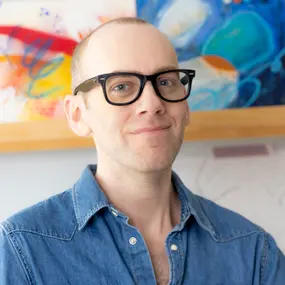
William Caleb Rivera-Bloodworth is an artist and designer based in Rochester, New York. As a lifelong creative, he rediscovered his passion for painting during the 2020 pandemic. As an Autistic, gay man from the Deep South living in New York, he navigates the world with a unique, outsider’s perspective that he actively seeks to include in his art.
When not painting, he is a professional marketer in the nonprofit sector. He is a Broadway obsessive, lifelong book nerd, HGTV addict, and LEGO builder. He speaks six languages and can manage to be a silly goose in all of them. And every day, he drinks coffee like he's one of the Gilmore Girls.
In 2026, he created winterROCs, a new midwinter festival and art fair in Rochester.


